Mathematics, made clear
Understand Before You Memorize
Our current seriesSOA Exam P & Exam FMYA Study Manual
Clear explanations, visual solutions, and practice organized around problem types. Go beyond knowing a formula to understanding why it works.
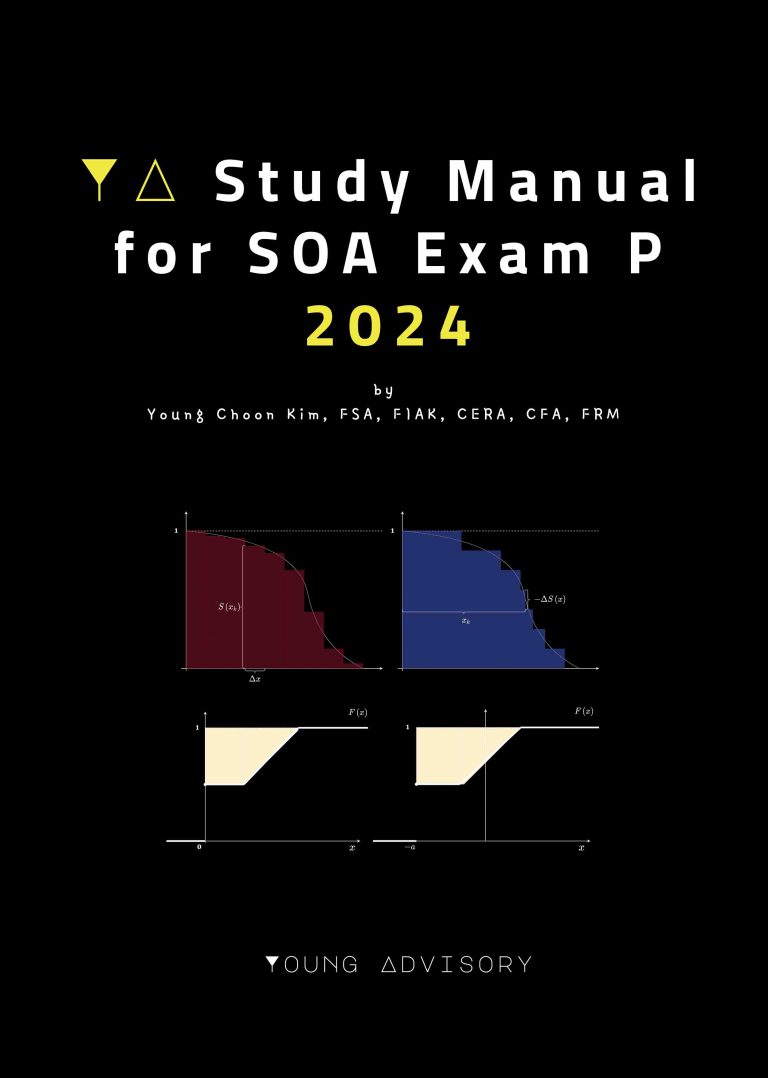
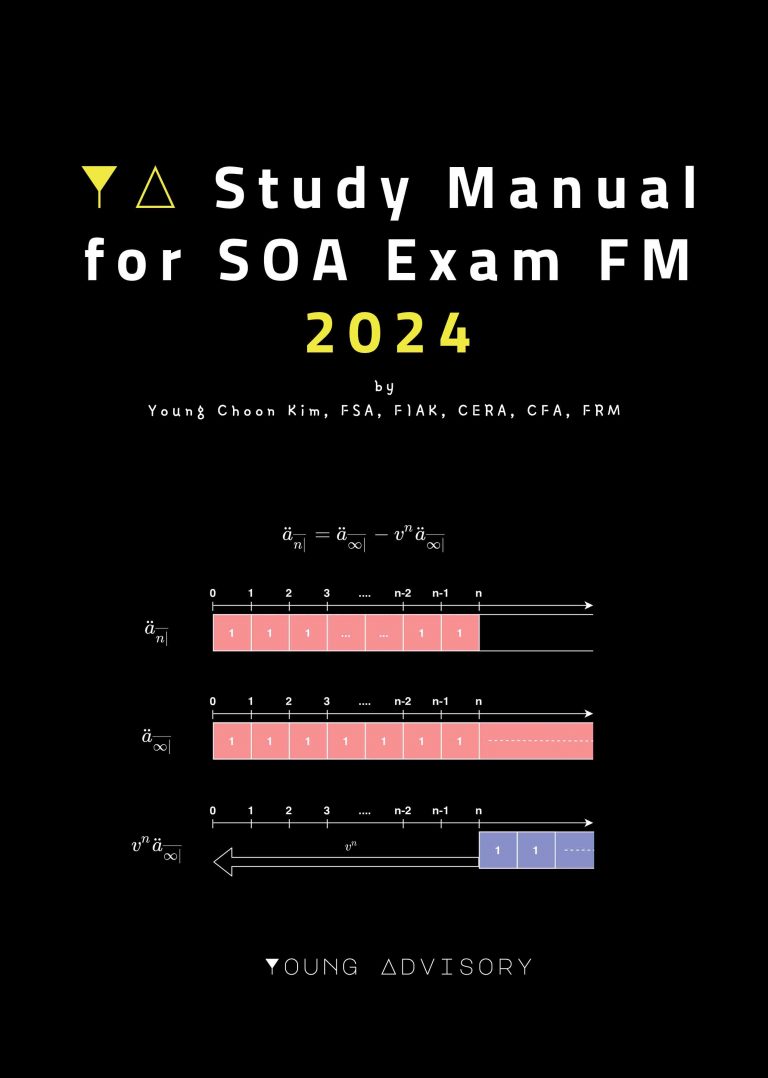
YA Study Manual · Probability & Financial Mathematics
The YA Study Manual series
Find your next chapter.
Two exams.
One clear approach.
YA Study Manual for SOA Exam P
Build your understanding of probability, then put it to work with detailed solutions. Connect the concepts behind a problem with the steps needed to solve it.
YA Study Manual for SOA Exam FM
Make sense of financial mathematics through analogies, illustrations, and visual solutions. Understand what the formulas mean and how they apply to the problems you practice.
Read the reasoning
See the Approach in Action
Read the sample pages to see how the manuals explain concepts and work through problems. Decide whether the approach fits the way you learn.
01 Exam P · Probability
Make the
overlap visible.
Trace how policyholders belong to more than one set. Then follow the original explanation to see how the separate regions add up.
Compare the website diagram with the actual book page, or see how related questions are grouped by problem type.
Explore the region counts
| Auto only | 129 |
|---|---|
| Home only | 88 |
| Life only | 53 |
| Auto & Home only | 64 |
| Auto & Life only | 18 |
| Home & Life only | 23 |
| All three | 32 |
| At least one | 407 |
The question: How many policyholders hold at least one of auto, home or life insurance? The totals overlap, so adding them directly would count some people more than once.
Question details and key steps
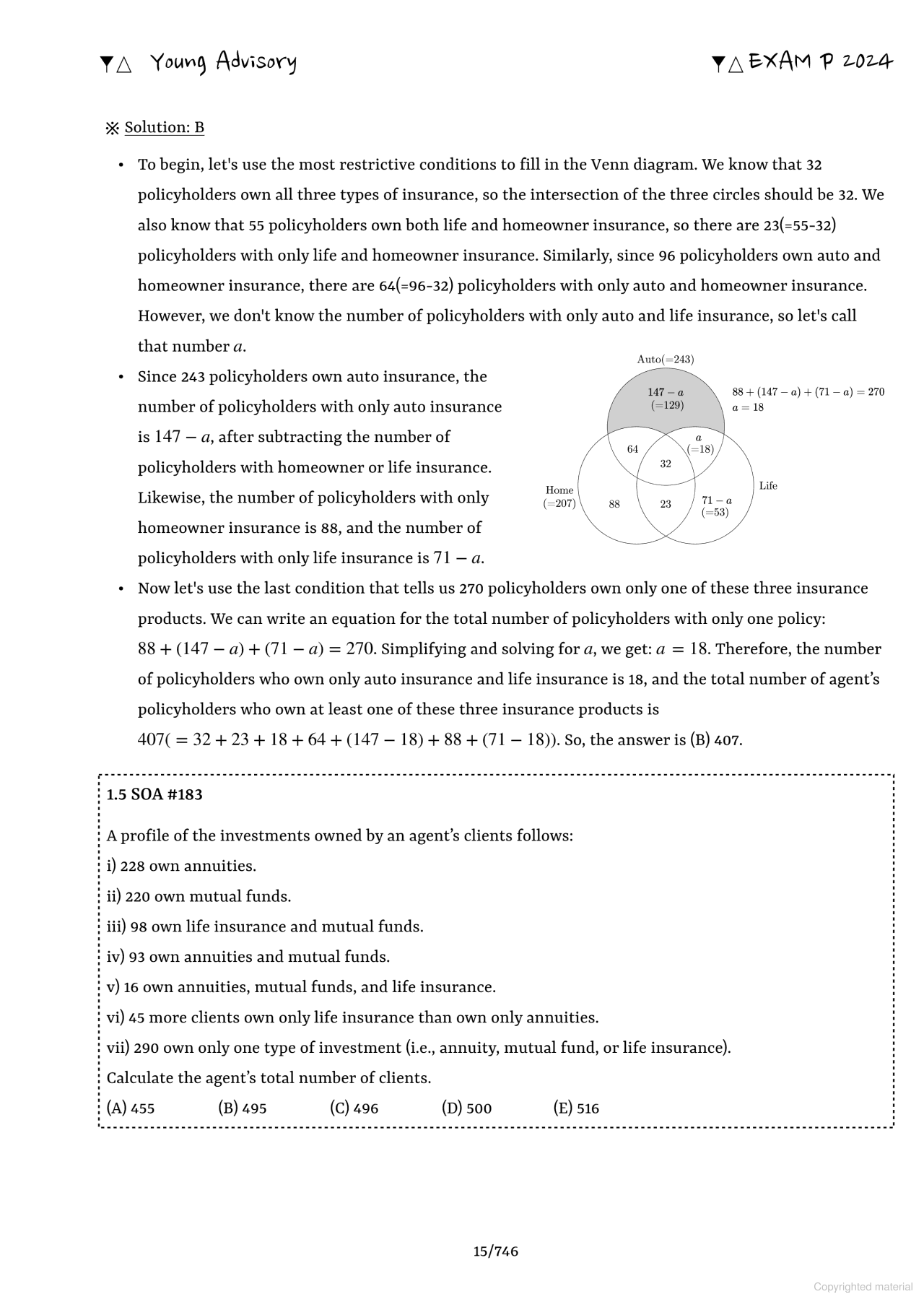
This is a summary of SOA sample question 182 ↗, worked through on the original book page below.
There are 243 auto and 207 home policyholders. The home/life overlap is 55, the auto/home overlap is 96, and 32 hold all three. Auto-only exceeds life-only by 76; 270 hold exactly one product.
Start in the centre: all three = 32. Subtract 32 from the two known overlaps to get home/life only = 23 and auto/home only = 64.
Let auto/life only be x. The single-product groups are 147 − x, 88 and 71 − x. Their total is 270, so x = 18. Adding the seven separate regions gives 407 policyholders.
Swipe across the page detail, or choose “Read full page” to zoom.
Swipe across the page detail, or choose “Read full page” to zoom.
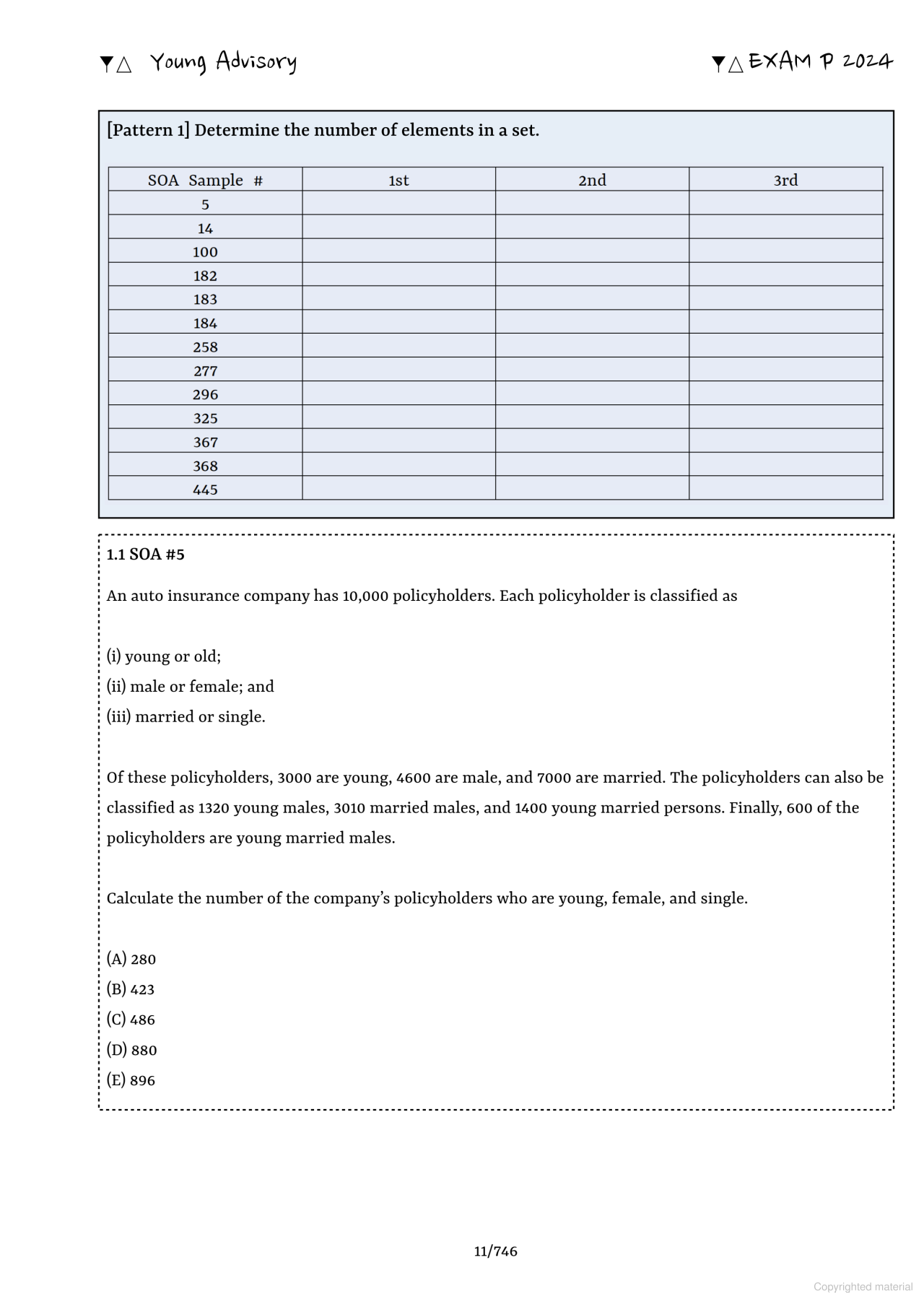
Swipe across the page detail, or choose “Read full page” to zoom.
The SVG is a website adaptation of the solution on preview page 15. Labels and line styles identify the sets; areas are not proportional to counts.
02 Exam FM · Financial Mathematics
Follow value
through time.
Follow how a value moves forward or backward through time. Compare the visual explanation with the original book page, then explore a cash-flow example.
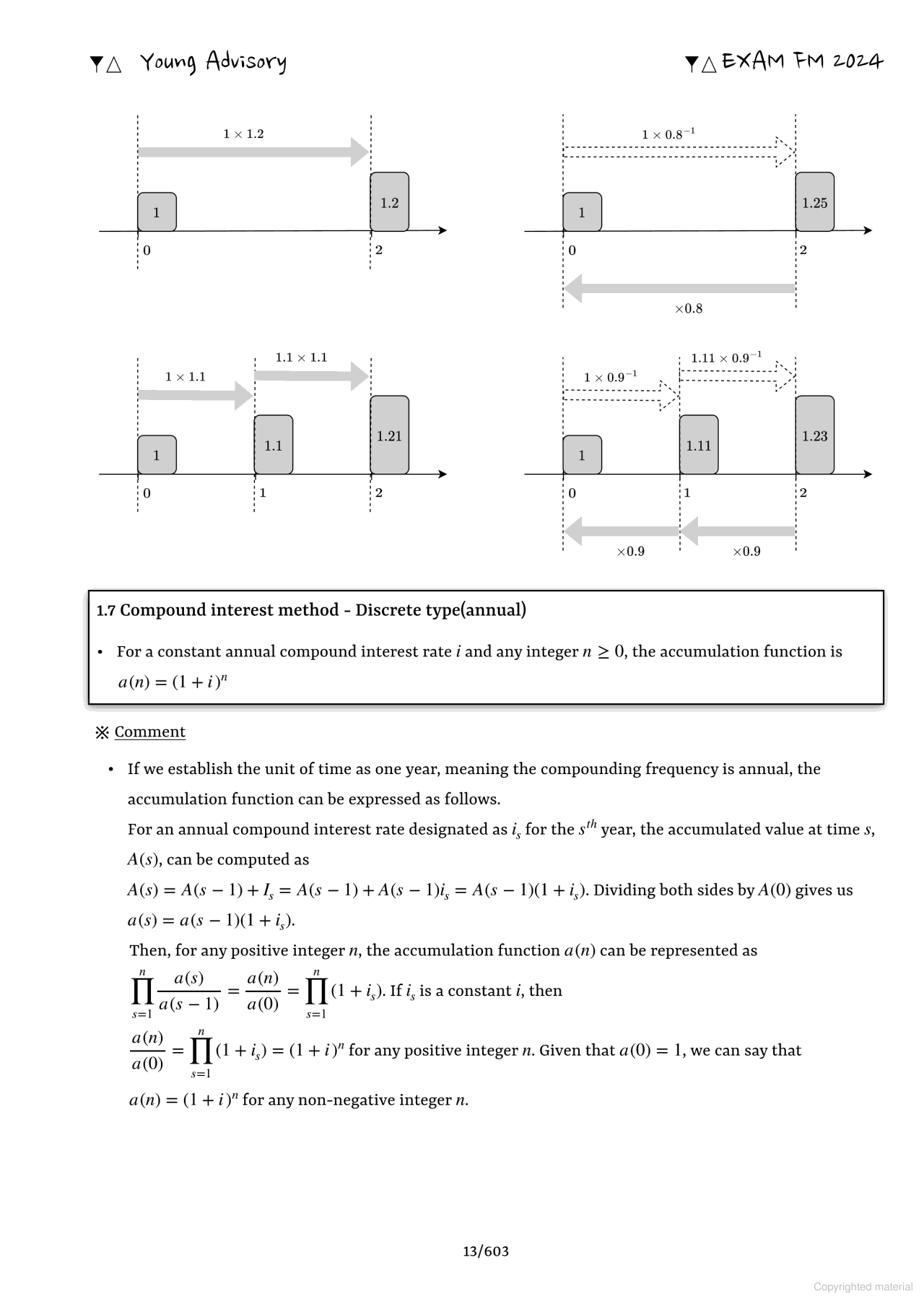
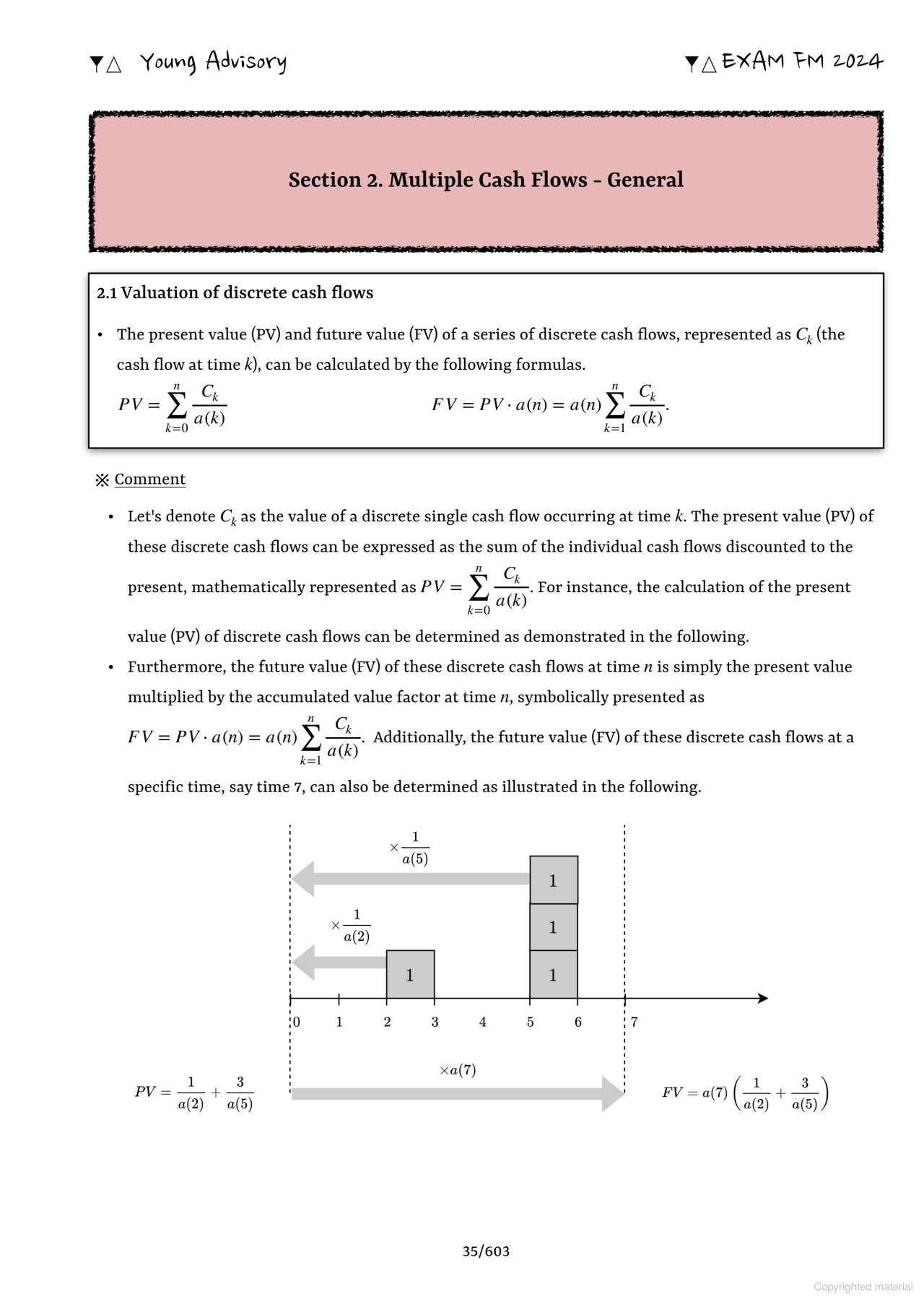
Page 13 connects the timelines with the compound-interest formula. Page 35 shows present and future values for multiple cash flows.
Compare with the original pages
Follow value through time. Compare accumulation and discounting on the timelines, then read the original compound-interest explanation. The cash-flow example brings payments at times 2 and 5 to a common date: time 0 for present value, or time 7 for future value.
Swipe across the page detail, or choose “Read full page” to zoom.
Swipe across the page detail, or choose “Read full page” to zoom.
Swipe across the page detail, or choose “Read full page” to zoom.
The visual explanation redraws the four timelines on page 13, retaining their values, operations and rounding. The original book pages are unchanged.
How we explain
From patterns to understanding.
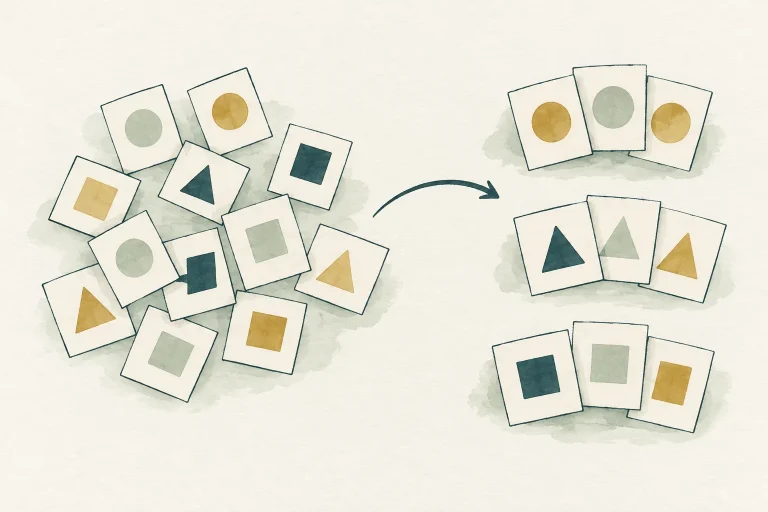
Study Simplified
Recognize the structure behind a problem. Practice organized by topic and question type helps you connect related questions instead of treating each one as something entirely new.

Intuitive Learning
Understand the ideas behind the formulas. Plain-language explanations connect concepts to calculations, so you can follow the reasoning—not just the steps.
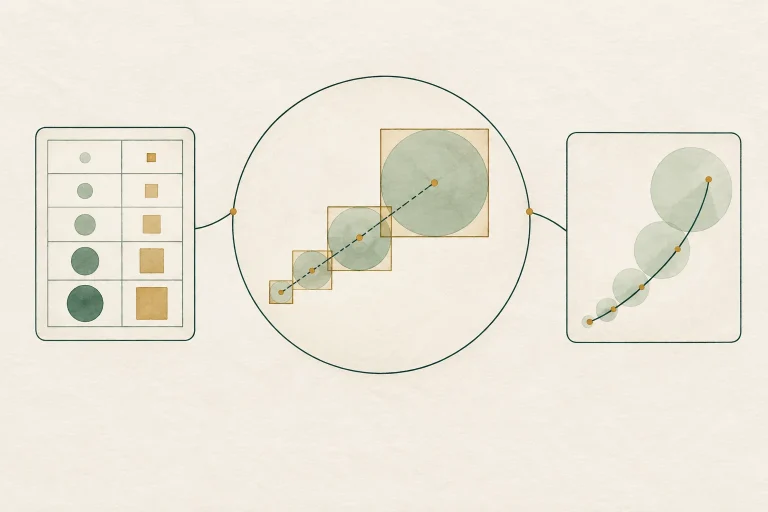
Visual Solutions
See how a solution fits together. Diagrams, figures, and tables make relationships visible and support the explanation alongside the mathematics.
Questions & feedback
Questions About the Manuals?
Have a question about YA Study Manual, or noticed a possible error? Get in touch.
For questions about a specific passage or solution, please include the exam, edition, page number, and question number, if applicable.